July 3, 2024
Unbelievably, despite fierce and legitimate resistance from the industry and criticism from various experts, including the Council of State, the Affordable Rent Act was passed by both the Upper and Lower Houses of the Dutch Parliament and entered into force on July 1. This gives everyone very little time to prepare for applying it correctly, while the legal monstrosity still contains many ambiguities and even impossibilities. Instead of diving into all the issues, let’s focus on a few of the consequences and – more importantly – opportunities of this act. It’s impossible to cover all the changes in this blog, but we’ll discuss the most important ones here.
Main points of the Affordable Rent Act
Implementation of this act has created a third category of properties: mid-segment rentals. The maximum permitted basic rent is decided via a residential property valuation points system (WWS). From the effective date of the act, properties can be divided into the following categories:
- Social housing up to and including 143 points (2024)
- Mid-segment rentals 144 points up to and including 186 points (2024)
- Deregulated sector 187 points and higher (2024)
The WWS is now binding. Previously, tenants could enforce it only by applying to the Rent Assessment Committee. As of 1 July, municipalities can enforce this system and even impose high penalties if a landlord rents a property in the social housing or mid-segment rental sector at an excessively high rent.
Shared rental properties
When letting a property to more than two people who don’t share a permanent communal household, the rent must be determined using the points system for non-self-contained residential properties. This also applies to current tenancy agreements, so claims that the act only applies to new tenancies are misleading.
Rent increases
The government sets the maximum rent increases for all three sectors. Each sector has slightly different methods and maximum rents.
Listed buildings
Under the old points system, listed buildings were automatically awarded an additional 50 points due to lower energy labels and higher maintenance costs. From 1 July 2024, no extra points are awarded. Instead, a 35% surcharge is added to the rent. Consequently, some listed buildings will move from the deregulated sector into the social housing or mid-segment rental sector.
Monitoring
The new law will be reviewed every three months to check whether the stock of mid-segment rentals remains stable. After a year, it will undergo a thorough evaluation. Mona Keijzer, the new Minister for Housing, strongly opposes this law, raising questions about its longevity or possible amendments.
What do you need to do now?
Current tenancy agreements will generally remain unchanged unless the property comes under the transitional law* or has been let to more than two people sharing the property.
For properties let after July 1 2024, the Affordable Rent Act applies in full. Steps you need to follow (together with an expert) include:
- Determine the number of points of a property on huurcommissie.nl.
- If the total is 187 points or higher, you can let the property at market rent without a maximum rent.
- If the total is below 187 points, the property falls under social housing or mid-segment rental, and the maximum basic rent is determined using the “Maximale huurprijsgrenzen voor zelfstandige woningen” table.
This act imposes additional restrictions but also offers opportunities, such as adjusted options for temporary rentals or letting properties profitably in the mid-segment rental sector. The key is to obtain customized advice — which is exactly what we provide. We have been advising clients for over 25 years, including on this new law.
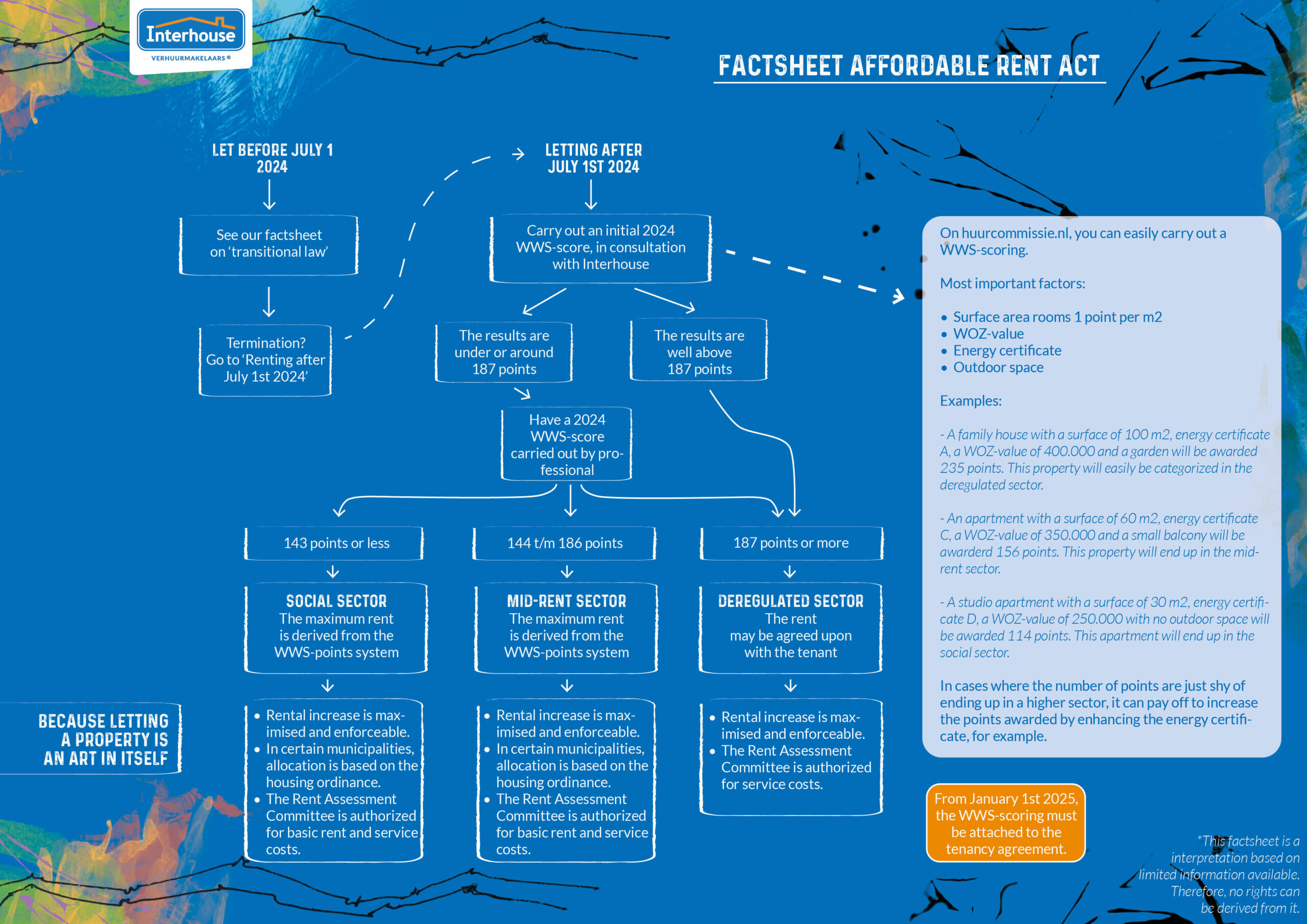
*The transitional law is complex and potentially conflicts with the ban on retroactive legislation. Properties with more than 143 points do not fall under the transitional law, and the Affordable Rent Act only applies when tenants change. Our offices can advise on the transitional law and all aspects of the Affordable Rent Act.

More from our blog:

Temporarily letting a property meant for your studying child, this is how it works afer July 1st 2024
When Will and Lilian heard their daughter Sophie was accepted at Leiden University, they couldn’t wait to celebrate! Soon after, the ...

Housing permit The Hague
New rules for tenants and landlords came into effect in July 2019. This may have been some time ago, but if you have not previously looked for a ...